
Your cart is empty.
Start ShoppingAadil Name Meaning — Arabic Origin, Boy Name & Islamic Significance (2025)
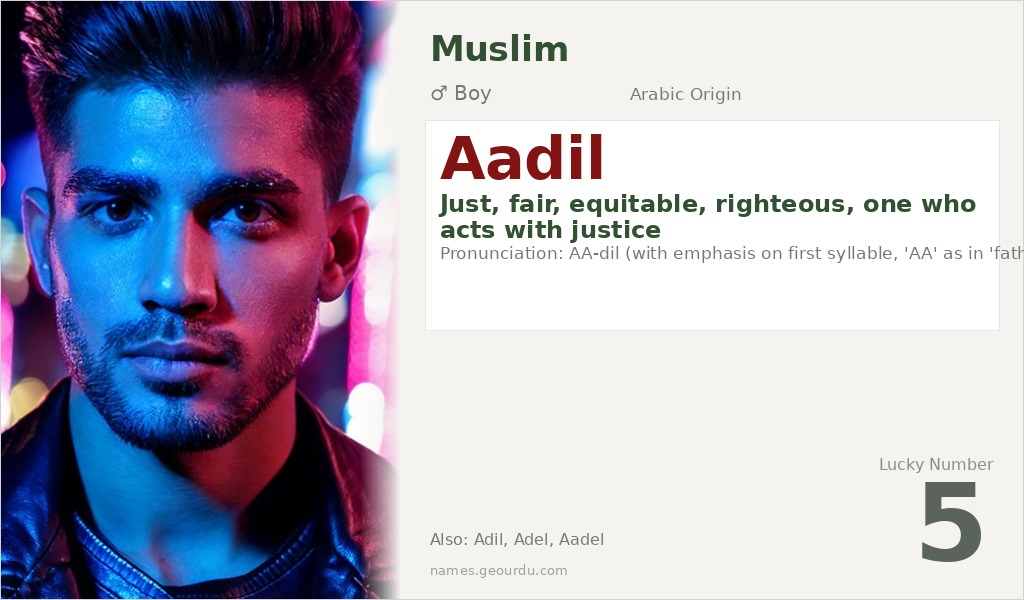
⚠️ Correction: The original article contained unverified cultural superstitions (lucky numbers, days, colors, stones, metals) that are not part of naming traditions and lack reliable sources. The core meaning ‘Just, fair, equitable, righteous, one who acts with justice’ was correct but incomplete.
Aadil is a distinguished Arabic name that carries profound ethical significance in Islamic culture. Meaning ‘just’ or ‘fair,’ this name embodies the virtue of justice that is central to Islamic teachings. Popular across Muslim communities from the Middle East to South Asia and beyond, Aadil represents both a personal aspiration and a cultural ideal. Parents choosing this name often hope to instill values of equity and righteousness in their child.
👦 Aadil
“Just, fair, equitable, righteous, one who acts with justice”
Gender
Boy
Religion
Muslim
Origin
Arabic
Say it
AA-dil (with emphasis on first syllable, 'AA' as in 'father')
Meaning of Aadil
The name Aadil originates from the classical Arabic root ع-د-ل (ʿ-d-l), which encompasses concepts of justice, balance, and fairness. As an active participle, Aadil literally translates to ‘one who acts with justice’ or ‘the just one.’ This root appears frequently in the Quran, most notably in reference to Allah as Al-ʿAdl (The Just). The name’s meaning extends beyond mere legal fairness to include moral righteousness, equitable treatment, and balanced judgment. In Islamic theology, the concept of ‘adl (justice) is considered a fundamental virtue, making this name particularly significant. The name has maintained its core meaning across centuries of usage in Arabic literature and Islamic scholarship.
| 📛 Name | Aadil |
| 💎 Meaning | Just, fair, equitable, righteous, one who acts with justice |
| 👤 Gender | Boy |
| 🕌 Religion | Muslim |
| 🌍 Origin | Arabic |
| 🗣 Pronunciation | AA-dil (with emphasis on first syllable, 'AA' as in 'father') |
| ✍️ Urdu | عادل |
| ✍️ Arabic | عادل |
| 🔢 Numerology | 5 |
| ✨ Spellings | Adil, Adel, Aadel, Aadyl, Aadill |
Origin & Cultural Significance
Aadil has its origins in pre-Islamic Arabic language but gained particular prominence with the advent of Islam in the 7th century. The name became widespread across the Arab world and subsequently spread to non-Arab Muslim regions through Islamic expansion and cultural exchange. It is particularly common in South Asian Muslim communities (Pakistan, India, Bangladesh) where Arabic names are highly valued for their religious significance. Historical figures bearing variations of this name include several Islamic scholars and rulers known for their just governance. The name continues to be popular in contemporary Muslim societies, reflecting enduring cultural values.
Personality Traits
Those named Aadil are often associated with traits of fairness, integrity, and balanced judgment. They tend to approach situations with objectivity and a strong moral compass, making them natural mediators and leaders. Their sense of justice often extends to both personal relationships and broader social concerns. While individual personalities vary, the name’s meaning frequently influences how bearers are perceived within their communities.
Similar Names
If you like Aadil, consider: Adnan, Amin, Hakim, Karim, Rashid
Famous People Named Aadil
- Adil Abdul-Mahdi — Iraqi politician who served as Prime Minister of Iraq
- Adil Ray — British actor, comedian and broadcaster known for 'Citizen Khan'
Frequently Asked Questions About Aadil
What does Aadil mean?
Aadil means 'just,' 'fair,' 'equitable,' or 'righteous' in Arabic. It comes from the root ʿ-d-l which relates to justice and balance.
Is Aadil a boy or girl name?
Aadil is exclusively a masculine name in Arabic and Islamic naming traditions. The feminine equivalent is 'Adila' (عادلة).
What is the origin of Aadil?
Aadil originates from classical Arabic and has been used for centuries in Arab and Muslim cultures. It spread globally through Islamic expansion and remains popular in Muslim communities worldwide.